Tuesday, May 29, 2012

HAL And UAC Sign Multirole Transport Aircraft Development Deal

Tue, May 29, 2012 11:12 CET
HAL and UAC will jointly develop the MTA program in Bangalore and Kanpur, India.India
India’s aerospace giant Hindustan Aeronautics Ltd has signed the tripartite General Contract for the Multirole Transport Aircraft (MTA) project with Russia’s United Aircraft Corporation -Transport Aircraft (UAC-TA) and partner JV-Multirole Transport Aircraft Ltd.

HAL will carry out the design & development of the project at its Aircraft R&D Centre in Bangalore, while the Transport Aircraft Division (TAD) in Kanpur will manufacture the prototypes.

Manufacturing and flight testing will be conducted with the Russian team in Moscow and India. India’s objective will be to achieve self-reliance and indigenously develop the design and production of aircrafts.

Cargo and troop transport will be the priority while structuring the aircraft, it will be designed to para or air drop of supplies including Low Altitude Parachute Extraction System (LAPES) and is to be co-developed by HAL and UAC & Rosoboronexport of Russia through a Joint Venture Company (JVC).

The current requirement is at 205, the Russian Air Force needs 100 aircraft while the Indian Air Force will receive 45 and the remaining 60 will be sold to other countries.

By defenceworld.net

Monday, May 28, 2012

Finish Army to Field Israeli Soldier Systems

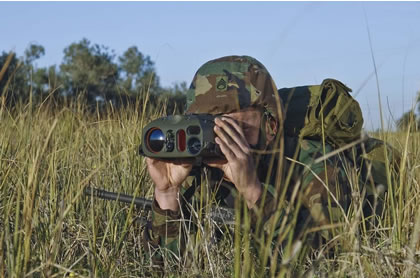
The Finnish Army has selected the Israeli company Elbit Systems to supply ‘soldier systems’ equipping Finnish infantry commanders to function command, control and communications in dismounted operations. This acquisition is the first phase of a comprehensive ISTAR (Intelligence, Surveillance, Target Acquisition and Reconnaissance) program known as STAR. The solution offered by Elbit Systems includes the compact MARS handheld targeting device, coupled with a computer systems loaded with situation awareness software, connected through the man-portable PNR1000 wearable soldier radio. The system is intended to enhance the operational capabilities of the Finnish Army in the areas of reconnaissance, terrain dominance and dismounted operations. The new system will also support the Finnish Army in developing new combat doctrines, and as a basis for developing its future forward observation program.


Bezhalel (Butzi) Machlis, General Manager of Elbit Systems’ Land and C4I Division, commented: “We are proud that Finland, a NATO Partner of Peace, has selected our systems following a rigorous competition, including field testing in Lapland. This win affirms yet again our leadership as a supplier of advanced solutions for soldier systems.”

The ‘future soldier’ program for the Finnish Army known as ‘Warrior 2020′ is currently conducted on a parallel path, under the Technology Programme 2010 (TP2010) framework spanning four years of evaluation and development of advanced soldier systems for the Finnish Army, scheduled to be fielded by 2017. The Finnish Army is seeking three different versions of the suite, designed for the Regular forces, Territorial Army, and Special Operations. Prime contractor of the TP2010 program is the British company Savox, with Finnish EO manufacturer Millog, network expert Nethawk and Instra acting as subcontractors.


By defence-update.com

Afghanistan crash, attack kills 3 NATO troops

KABUL, Afghanistan — A helicopter crash killed two NATO service members in eastern Afghanistan on Monday, while a third died in an insurgent attack in the south, the U.S.-led coalition said.

Authorities are investigating the cause of the crash, but initial reports indicate there was no enemy activity in the area at the time the helicopter went down, the coalition said.

No further details about the crash in the east or the insurgent attack in the south were released.

The deaths raised the number of NATO troops who have been killed in Afghanistan this year to 172.

Also Monday, a second coalition aircraft crashed in eastern Afghanistan, but no fatalities were reported. The coalition said this incident was not related to the helicopter crash that also occurred in the east.

Officials are trying to determine why the aircraft went down, but initial reports indicate there was no enemy activity in the area. There were no reports of civilians being harmed or property damaged during the incident. The coalition transported the aircraft’s crew and passengers to a nearby base for evaluation


The Associated Press
Posted : Monday May 28, 2012 9:31:37 EDT

Afghans ‘Concerned’ Over Air Force as NATO Pulls Out

KABUL — Afghanistan’s defense ministry has expressed concern over the slow pace of developing its air force ahead of a scheduled withdrawal of NATO troops and equipment, the government said May 27.

More than a dozen transport aircraft provided to the Afghan air force by the United States have been grounded because of age, a lack of spares and safety problems, President Hamid Karzai’s office said in a statement.

The issue was raised at a security meeting which was told that the defense ministry was “concerned over the slow pace of reviving the country’s air force” and wanted the U.S. to “intensify its efforts for that end”.

As part of its exit strategy from the Afghan war, the U.S. is helping Kabul build its air force before most air support from NATO forces is withdrawn along with 130,000 troops by the end of 2014.

Fifteen C-27 transport aircraft supposed to provide support to the Afghan army and deliver humanitarian aid had been grounded for two years, defense ministry spokesman Zahir Azimi told AFP.

“The planes were made in Italy, they are old and were out of the Italian fleet before they were given to Afghanistan,” Azimi said.

Air transport is critical in Afghanistan, where the road network is underdeveloped and targeted by insurgent bombings, while strike aircraft are a vital part of the war against Taliban insurgents.

The U.S. Air Force announced last month that it was reopening a contest for a contract to build 20 light attack aircraft for Afghanistan after the cancellation of an award to Brazil’s Embraer two months earlier.

But a final decision for the contract will not be made before early 2013, the Air Force said in a statement, with the first planes due to be delivered in the second half of 2014.

The new schedule will mean “a delay of about 15 months” from original plans, before the Air Force called off the award, the statement said.

Last year, an Afghan air force officer shot dead nine U.S. service members at a training center at Kabul International Airport, one of the deadliest attacks on coalition troops in recent years.

It was one of an increasing number of attacks in which Afghans being trained by NATO troops have turned their weapons on their mentors.


May. 27, 2012 - 11:19AM |
By AGENCE FRANCE-PRESSE

Two Tibetans self-immolate in Lhasa

May 28, 2012 14:58 Moscow Time
Two Tibetans self-immolate in Lhasa
Photo: EPA
Print Email Add to blog

Two young Tibetan men set fire to themselves in the centre of Lhasa, the capital of China's Tibet Autonomous Region, reports said on Monday.

Police smothered the flames and took away the two men minutes after their protest on Sunday afternoon outside Lhasa's Jokhang temple, one of the holiest sites for Tibetan Buddhists, US-based Radio Free Asia and China's official Xinhua news agency reported.

"Some who tried to go close to the site were also detained and taken away while mobile phones of those who were close to the site were confiscated," Radio Free Asia quoted a witness as saying.

Xinhua quoted local officials as saying one of the men died and the other suffered serious injuries.

It named them as Dargye from the restive Ngaba Tibetan area of China's Sichuan province, and Tobgye Tseten from Xiahe county in neighbouring Gansu province.

The Chinese government has tightened security in most Tibetan areas this year after an escalation of anti-government protests and more than 30 self-immolations, many of them by monks.


By Moscowtimes.com

U.S. Navy to Deploy 4G LTE Network on Three Ships

Tiffany Kaiser - May 24, 2012 3:10 PM
In addition to the WWAN, the sailors will receive Android smartphones to deliver the critical information over the network

The U.S. Navy is stepping into the 21st century with the first-ever 4G LTE wireless network being placed on three ships.

Currently, the Navy uses satellites for connectivity across large oceans. Bandwidth is an expensive and scarce asset, and when sailors use recreational computers, it's usually limited to dial-up type speeds.

However, this is all about to change as the Navy plans to deploy a microwave-based wireless wide area network (WWAN) on three different ships. The 4G LTE network will be placed on the U.S.S. Kearsarge, which is an amphibious assault ship; U.S.S. San Antonio, an amphibious transport dock; and U.S.S. Whidbey Island, a dock landing ship.

The network will allow sailors to send real-time data like text, photos and videos easily. While the network is faster at 300 megabits of data per second, it can't replace satellites because it only works from distances of up to 20 nautical miles. While this can't keep a fleet connected, it can keep a naval task force connected.

The network is being provided by Indiana-based BATS Wireless along with Oceus and Cambium. The idea behind the network is to allow sailors to board an ersatz vessel hijacked by pirates and send real-time data back to the "mothership."

"What we've collectively developed is a ruggedized, ocean-going LTE network similar to what you'd find with telecom providers like Verizon or AT&T," said Phillip Cramer, a vice president at BATS wireless. "The biggest difference being that it can expand, contract, and move seamlessly; delivering critical data and communications to the soldiers who need it most."

In addition to the WWAN, the sailors will receive Android smartphones to deliver the critical information over the network. The Navy went with Google's Android-powered devices because they are cheaper than other options and can be secured to transfer classified information. The U.S. Army uses Android devices as well.

This is the Navy's first dip into the mobile world. There will be a sea trial for the new network at an undisclosed time.

U.S.S. Kearsarge (Source: ubergizmo.com)

by dailytech.com

Sunday, May 27, 2012

Top Israeli officials have refused to meet the US envoy to the P5+1 group, who arrived in Jerusalem with a report on recent talks with Iran. The diplo

Published: 26 May, 2012, 20:24

Israel's Prime Minister Benjamin Netanyahu (L) speaks with Defence Minister Ehud Barak (Reuters / Ronen Zvulun)

Israel's Prime Minister Benjamin Netanyahu (L) speaks with Defence Minister Ehud Barak (Reuters / Ronen Zvulun)

Top Israeli officials have refused to meet the US envoy to the P5+1 group, who arrived in Jerusalem with a report on recent talks with Iran. The diplomatic démarche comes as relations between the two countries strain over Tehran’s nuclear ambitions.

­Under Secretary of State for Political Affairs Wendy Sherman arrived in Israel on May 25, a day after the group of six (Britain, China, France, Russia, and the United States plus Germany) ended their unsuccessful negotiations in Baghdad.

She had intended to brief Israeli officials about negotiations between Iran and the P5+1. But both Israeli Prime Minister Benjamin Netanyahu and Defense Minister Ehud Barak became unexpectedly unavailable to meet her.

Sherman then delivered her report about the fruitless talks to National Security Adviser Yaakov Amidror and Foreign Ministry Director-General Rafi Barak instead, the Debka news agency reported.

No agreement was reached between the world powers and Iran during the talks in Baghdad on May 23-24 because Tehran refused to meet their demands. The P5+1 wanted Iran to suspend its 20 percent uranium enrichment program, which the group sees as vital to the negotiations process.

Tehran labelled the Western proposal ‘unbalanced’, rejecting it over what it called "unfair demands" which offer little in return.

Even though both sides still hope to hammer out the agreement at a newly-scheduled round of talks in Moscow next month, Israel remains less optimistic about the negotiations.

On the first day of discussions in Baghdad, on May, 23, Defence Minister Ehud Barak said the negotiations only allow Iran to buy time and drive a wedge between Washington and Tel Aviv.

Relations between Israel and United States have become more tense lately, with both countries having different solutions to the conflict with Iran.

While the US prefers warnings and sanctions to pressure Iran away from any suspected atomic weapon development, Israel threatens military action.

On the talks’ opening day, Ehud Barak reaffirmed Israel’s position, saying a military strike against Iranian facilities is not out of the question.

What’s more, a day later, a source in Washington DC said the Israeli leadership had backtracked on a promise not to attack Iran before America’s November presidential election, according to the Debka report.

The possible use of force against Iran has been discussed by Israel and its western allies for months. Israel insists on the right to strike if and when it sees fit, saying it will not seek anyone’s consent.

There is a fear that, if such an attack happens, Iran would retaliate against any forces it sees as enemies, which could result in a major regional war, dragging in other countries as well.

Israel will only accept Iran developing its civilian nuclear industry is if it shuts down all its uranium enrichment sites and uses imported fuel, Barak said. Essentially, that is what the P5+1 group offered Iran this time. But Tehran still insisted it did not intend to create a nuclear bomb and, as "proof", agreed on the eve of negotiations to the resumption of UN nuclear monitoring at Iran’s sites, including Parchin.


by rt.com